

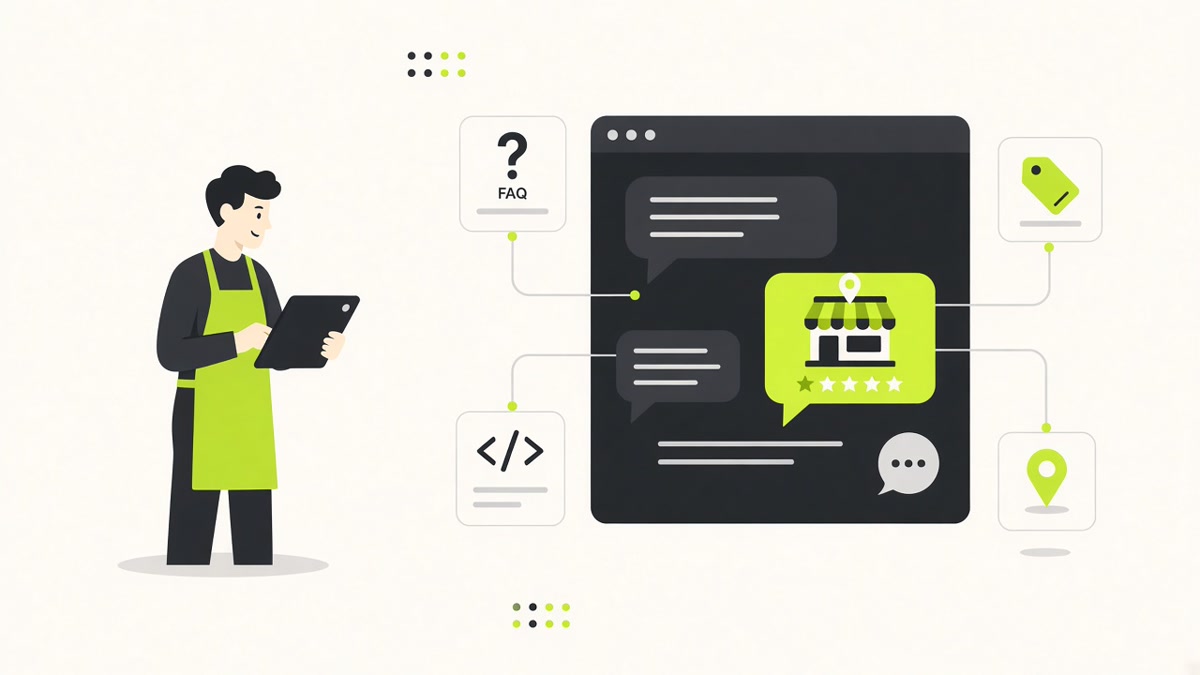
I get asked this a lot: how do I get my business recommended by ChatGPT? The short answer is you cannot pay for it and nobody can guarantee it, but you can control what information is available for AI tools to find. If you make your website clear, structured, and helpful, and you do not block AI crawlers, you give yourself the best chance.
Clients have started asking because people are using AI tools every day. ChatGPT, Claude, Perplexity, and Google's AI Overviews are answering questions that used to land on a Google search results page. If someone asks "who does bathroom renovations in Subiaco" or "best plumber near me for hot water system", an AI tool might recommend a business by name. That business could be yours, or it could be a competitor.
This article explains what you can actually control, what I have seen work, and where the AI SEO industry sits right now.
Why AI tools recommend some businesses and not others
AI tools like ChatGPT pull information from the web. They look at your website, your Google Business Profile, online directories, reviews, and any other public information they can crawl or access through search providers. When someone asks a question, the AI tool searches for relevant information, reads it, and generates an answer. If your business is mentioned clearly and matches what the person is asking, it might get recommended.
There is no secret backdoor. OpenAI has stated that ChatGPT search uses third-party search providers (including Bing) and can also crawl sites directly using a bot called OAI-SearchBot. Google's AI Overviews work the same way: standard SEO best practices apply, and there is no special schema or AI markup required.
The businesses that show up are the ones with clear, structured, helpful information that AI tools can find and understand. That is what you can control.
What you can control to show up in ChatGPT
Clear service and suburb pages
AI tools cannot recommend you if they do not know what you do or where you work. Your website needs individual pages for each service you offer, and you need to name the suburbs or regions you cover.
A plumber offering hot water, blocked drains, and gas fitting should have a page for each service. An electrician doing switchboard upgrades, EV chargers, and solar should split those into separate pages. A single "Services" page that lists everything in dot points is not enough. AI tools (and Google) need clear signals about what each page is about.
The same applies to location. If you work across the northern suburbs, say that. If you cover Perth metro, list the main areas. A page titled "Plumber Perth" that never mentions which suburbs you serve leaves the AI tool guessing.
I have covered the structure in more detail in the guide on what tradies need on their website, but the short version is: one page per service, location clearly stated, and real information rather than vague marketing copy.
Transparent pricing and information
One pattern I have noticed across the sites I build: in my experience, being transparent about pricing and information in general helps a lot. That includes:
- Service pricing (even if it is a range or a starting price)
- What the service includes
- How long it takes
- What areas you cover
- Business hours and emergency availability
- Licences and insurance
AI tools are trying to answer a person's question. If someone asks "how much does a bathroom renovation cost in Perth" and your site clearly states your pricing structure, you are more likely to be mentioned than a competitor who hides all pricing behind a "get a quote" form.
You do not need to publish every price for every variation of every job. A starting price, a typical range, or a clear explanation of what affects the cost is enough. Transparency helps.
FAQs that answer real customer questions
I add an FAQ section to most of the sites I build. It helps with SEO, it helps customers, and it helps AI tools. The FAQ should answer the questions customers actually ask, not generic filler.
Examples for a plumber:
- Do you offer same-day service?
- What areas do you cover?
- Are you licensed and insured?
- How much does it cost to fix a burst pipe?
Examples for a builder:
- Do you handle council approvals?
- What is included in your fixed-price quote?
- Do you work on renovations as well as new builds?
- How long does a typical extension take?
Those questions come up in real conversations, and they are the kinds of questions people ask AI tools. If your site answers them clearly, the AI tool can pull that information and present it in the response.
If you only have an hour to improve your site, adding a well-written FAQ section is one of the highest-value changes you can make.
Schema markup
Schema markup is structured data you add to your website's code that tells search engines and AI tools what your business does, where you are, and what services you offer. It is not visible to visitors, but it makes your site easier for machines to read.
Google has said you do not need special AI schema to show up in AI Overviews, and OpenAI has not published any specific schema requirements for ChatGPT. That said, standard schema types like LocalBusiness, Service, FAQPage, and Review are still good practice and they help AI tools understand your site.
I add schema markup to every site I build as part of the base SEO setup. You do not need to see it or understand it. It just works in the background.
Consistent name, phone, and address everywhere
Your business name, phone number, and address (if you publish one) need to match across your website, Google Business Profile, invoices, directory listings, and anywhere else your business appears online.
If your GBP says "Smith Plumbing Services" and your website says "Smith Plumbing Pty Ltd" and a directory listing says "Smith's Plumbing", Google and AI tools cannot be sure they are looking at the same business. Pick one version and use it everywhere.
This is basic local SEO, but it matters for AI recommendations too. Consistency builds trust with both search engines and AI tools.
Google Business Profile and reviews
Your Google Business Profile is one of the main sources AI tools pull from. Keep it updated: correct phone number, business hours, service area, services offered, and regular posts if you can manage it.
Reviews matter. AI tools consider them when deciding what to recommend. A plumber with 50 reviews and a 4.8-star average is more likely to be mentioned than a plumber with three reviews and no recent activity.
You cannot fake this. Ask happy customers for reviews after you finish a job. Send a follow-up text or email with a link to your GBP. Most people are willing to leave a review if you make it easy.
The guide on Google Business Profile setup covers the full process if you need help getting it right.
Make sure your site is indexed in Google and Bing
ChatGPT search uses third-party search providers, and Bing is one of them. That means your site should be indexed in both Google and Bing. Most sites are indexed automatically, but you can check by searching site:yourwebsite.com.au in Google and Bing.
If your site is not showing up, submit it through Google Search Console and Bing Webmaster Tools.
Do not block AI crawlers
OpenAI's bot is called OAI-SearchBot. If you block it in your robots.txt file, your site will not appear in ChatGPT search results. Most sites do not block it by default, but if someone set up your site with aggressive bot blocking, it might be excluded.
Your web developer can check this. If you want to be sure, they can add this to your robots.txt file:
User-agent: OAI-SearchBot
Allow: /
Google's AI Overviews use Googlebot, so if you are allowing Google to crawl your site (which you should be), you are already covered there.
It can take around 24 hours after a robots.txt change for OpenAI's systems to adjust, according to their official documentation.
Real example: a tennis coach showing up in ChatGPT
I worked on a site for a tennis coach client using the same approach described above: schema markup, FAQs, Google Business Profile, and transparent information about their services and pricing. They now show up when I test ChatGPT and Claude.
I cannot promise that will happen for every business, but it shows that the approach works. Clear information, structured properly, on a site that AI tools can crawl.
What about AI SEO packages?
Most agencies sell AI SEO or GEO (generative engine optimisation) packages these days.
If you are considering one of these packages, ask what is actually included. Is it schema markup? Content rewrites? Technical SEO? Directory submissions? Or is it just the same service you could have bought last year with a new name?
Nobody can guarantee what an AI tool will recommend. If an agency promises you will show up in ChatGPT or Claude within a certain timeframe, they are selling something they cannot control.
What they can control is making your site as clear, structured, and accessible as possible. That is the work that matters.
If you only have an hour: start here
If you are a tradie or small business owner and you only have an hour to spend on this, focus on these three things:
Add transparent information to your website: pricing (even if it is a range), services you offer, suburbs you cover, and contact details. Make it easy for a visitor (or an AI tool) to understand what you do and where you do it.
Add or improve your FAQ section: answer the questions customers actually ask. Make it specific to your trade and your area. If you do not have an FAQ section yet, create one.
Check your Google Business Profile: make sure your phone number, business hours, service area, and services are up to date. Ask a recent customer for a review.
Those three changes take less than an hour and they improve your chances of being recommended by AI tools. They also improve your chances of getting a phone call or a quote request, which is the actual goal.
If your site does not have those basics in place yet, that is where to start.
Why some sites still are not showing up
Even if you do everything right, there is no guarantee. AI tools use their own ranking systems, and those systems change. What works today might work differently in six months.
Some reasons your business might not show up:
- Your website does not have enough information for the AI tool to understand what you do.
- Your competitors have more detailed, structured content.
- Your Google Business Profile is incomplete or inactive.
- You are in a competitive industry where dozens of businesses offer the same service in the same area.
- The AI tool pulled information from a different source (a directory, a competitor, or a news article).
- The question someone asked did not match what your business offers closely enough.
You can improve your odds, but you cannot force a result. Focus on building a site that is clear and helpful for actual customers, and the AI side will follow.
What if your website is not getting enquiries at all?
If your site is not generating phone calls or quote requests, the AI question is secondary. Fix the fundamentals first.
I wrote a guide on why your website is not getting enquiries that covers the most common problems: missing conversion paths, vague services, no clear call to action, buried contact details, and sites that do not work on mobile.
Get that right before worrying about ChatGPT. A site that converts visitors into customers is more valuable than a site that gets mentioned by an AI tool but does not generate work.
Next step: get your site set up properly
If you are a Perth tradie or small business owner and your website does not have the basics in place yet, that is the place to start. Clear service pages, transparent pricing, an FAQ section, and a properly set up Google Business Profile are the foundation.
AI answers sit on top of normal search work. For a plain timeline once the sitemap and Google profile are in place, read how long SEO takes for a Perth tradie. Ongoing search support is on SEO services.
I build WordPress sites for Perth small businesses and tradies, including plumbers, builders and architects. See the breakdown on the pricing page.
If you want help getting your site set up to show up in AI tools (and in Google search, and in front of actual customers), get in touch or call 0494 888 153. I will let you know what needs to change and quote a package or a custom scope to get it done.
The goal is not just to show up in ChatGPT. The goal is to get more enquiries from people who are ready to book a job. AI visibility is part of that, but it is not the only part.
Focus on making your site clear, structured, and helpful. The rest follows.